Showing posts with label Grace's Pictures. Show all posts

Friday, June 6, 2014

Grace's Pictures Finds More Readers!


I love that my publisher's recent free promotion of the ebook edition of Grace's Pictures has generated new readers. There have been several new reviews on Amazon on Goodreads, and far and away (so far) they've been very positive. On Amazon the book is nearly at 100 reviews! Know anyone who would like to put the book past that mark? Send him/her over!

That's right, even men are enjoying the book. Here is what a recent reviewer on Amazon had to say:

Entertaining tale. This is a nice, clean, unique historical novel. Well written. Interesting characters. A book I would recommend to others. My husband enjoyed it as well, so not just a girly book.

I love that--not just a girly book! Exactly! :)

If you've read Grace's Pictures, and not yet posted a review, I'd love to hear what you thought. And I hope you'll pick up a copy of Annie's Stories, releasing soon!


*Click on the books tab above to order!

Tuesday, April 22, 2014

Goodreads Giveaway!

In anticipation of the release of Annie's Stories, I'm giving away a copy of book one in the series, Grace's Pictures. You can enter on Goodreads:


Goodreads Book Giveaway

Grace's Pictures by Cindy Thomson

Grace's Pictures

by Cindy Thomson

Giveaway ends May 21, 2014.
See the giveaway details at Goodreads.
Enter to win

Saturday, March 29, 2014

Places in My Novel Grace's Pictures

One of the places in my novel (Grace's Pictures) where a lot of the action takes place is Battery Park.

Not only is Battery Park a beautiful place to visit where you can watch boats and observe the Statue of Liberty, it is full of history--the very spot many of our ancestors first embarked after leaving Ellis Island.

Immigrants arriving in Battery Park.

When I was there I admired this statue and the old trees surrounding it, imagining that many early immigrants must have sat near it and rested from their journeys. If you read Grace's Pictures, you'll remember this statue.


At the edge of Battery Park is Castle Clinton, which at the time of my Ellis Island series was an aquarium.

Today

In 1917

So much history exists on that small stretch of a park. Certainly much has changed. There are many statues now, not just the Ericsson one. The trees have grown large. On the weekends the park is filled with tourists, many who are preparing to take the ferry over to the Statue of Liberty and Ellis Island. Street hawkers rest here, but there were certainly those in the era of my novels. And I noted something else. A rat scurried past me when I was there, and so Grace experiences the same thing in my novel. But don't let that deter you if you have the chance to visit. Go sit on a bench and watch the sunset and think about our immigrant ancestors arriving in that spot over a hundred years ago. That's what I was doing when I took this photograph.

©2012 Cindy Thomson

Monday, November 18, 2013

On Around Cincinnati, NPR

I had the pleasure of dropping by WVXU in Cincinnati to chat with Barbara Gray recently about my book, Grace's Pictures. You can listen in here:

http://wvxu.org/post/columbus-author-cindy-thomson

Wednesday, November 13, 2013

I'm Building a Street Team! Details here:

Thank you so much to everyone who read Grace's Pictures and took time to post a review. I’m so happy so many of you liked the book! That is why I’m asking readers like you if you’d be interested in joining my launch team (or street team) for the next book, Annie’s Stories, due out July 2014. It’s critical that this book get off to a great start so that I will be able to continue to bring you more stories. Critical, truly. This is a call to arms! Are you interested in helping?

If so, here is what I’m looking for:
People who…
  • ·      Are willing to post reviews as close to the launch date as possible. (I can see that you get an advanced reader copy a few months prior.)
  • ·      Have a following of at least 100 people on his/her blog and/or at least 200 followers on Facebook or Twitter.
  • ·      Are willing to tweet and/or Facebook about the book’s launch at least once per day during the week of the book’s launch. (Street team members will have access to pre-written tweets and Facebook statuses to copy and paste.)
  • ·      Are willing to request that the book be purchased at his/her’s local library.
  • ·      Are willing to contact local bookstores to request the book.
  • ·      Have creative ideas to help my series reach readers.


Think that might be you? I have limited spots, so please answer the questions below and email (cindyswriting @gmail .com) or message me the answers. I will choose the Street Team members from there, but everyone who responds will get something in return for his/her trouble.

  • Are you on any other Street Teams?
  • What are your favorite books?
  • Are you on social media? If so, what are your numbers on Facebook? Twitter? Instagram? Your blog? Etc.?
  • Do you have connections with local groups or organizations that you believe you could tap into to help promote me and my book? List them.
  • What ideas do YOU have to help promote me and my book that you’d be willing to spearhead?
  • Are you able to commit for a full year?

What’s in for you?
  • ·      A free signed copy of Annie’s Stories (not just the ARC.)
  • ·      Annie’s stories, the short stories Annie’s father wrote to her, mentioned in the novel. I will send them to you as soon as each is available. The first one is nearing completion now.
  • ·      One free Skype or Twitter chat with your group of five or more.
  • ·      Coffee with me if I happen to be in your area and we can meet up.
  • ·      Wee gifts and surprises. :)


Thanks again for reading and rating Grace’s Pictures!

Tuesday, July 16, 2013

Immigration: Hot Topic Then and Now

I don't have to tell you immigration is a hot topic in America today. Congress has been debating a bill all summer it seems. Who is here legally? Who has rights? Who doesn't? Who will take jobs from Americans? What immigration regulations need to be tightened or changed?

Sounds right out of today's headlines, doesn't it? But these are questions debated during the time I set my novel, Grace's Pictures.

Of course, the headlines weren't at all politically correct back then.


Harpers Illustration from 1898
And if you want to go further back in history you'll find those living in America discriminating against the new arrivals for as long as we've been recording our history.

There surely are important issues to settle. I'm not about to debate them here. But even so it never ceases to amaze me how history repeats itself. The above headline (or more accurately, sub headline) appeared in the New York Times, December 23, 1901. In the article one of the points to be addressed by Congress was:

"To add to the present law whatever seems to be necessary to meet the advanced judgment of those who have been studying the immigration question carefully for the last quarter of a century."

Cartoon from 1928.
It seems what was deemed necessary was to increase a "head tax" on aliens, triple it actually. They were concerned that the immigrations would become a burden, "criminals and paupers." Tracking these individuals would be costly, thus the need to tax them. Anyone with a contagious disease, the insane, anyone likely to become a public charge was to be deported. Likewise polygamists, anarchists, prostitutes and those bringing in prostitutes. In addition, anyone who was promised work in America
was to be deported. They could work after they got here, but no one needing labor was to look for it outside of the US instead of employing Americans already here. Interesting, huh? There were exclusions for musicians, actors, ministers, or those to be employed in domestic service. It's getting really complicated, isn't it?

The article writer concludes that those who have examined this new bill claim it is "quite up to date, that it is built intelligently on the experience of those who have been administering the immigration laws for years, and that it does justice to all interests which it affects."

Well, we can only hope our officials will keep this in mind today.


Friday, July 5, 2013

Win!! Prints That Inspired Grace's Pictures

Update: Mandy is the winner! Thanks for entering, everyone. If you'd like me to run another contest like this, just ask! :)

I would love to give these four prints away to one of my readers. If I get a good response, I may do it again and perhaps add some different ones. You can use these for crafts (lots of inspiration over on Pinterest!) or just frame them as a set. They are printed on book pages (not my book, but a library discard!) The photos are in the public domain, and I think they are quite charming. They helped inspire me as I wrote Grace's Pictures. What do you think?

Not crafty? Send one of your friends over and remind her you have a birthday coming up! ;-)

Saturday, June 22, 2013

What Police Corruption?

History of Police Corruption


In Grace's Pictures I write about police corruption in New York City at the turn of the 20th century. If you know history, you probably know Teddy Roosevelt headed the police commission from 1895-1897 and brought wide sweeping changes. Together with a photographer named Jacob Riis (who makes an appearance in my novel) they traipse through Lower Manhattan neighborhoods in the middle of night, waking up sleeping patrolmen and taking flash photographs of the horrid living conditions.

Roosevelt was familiar with Riis previous to taking the position on the commission, having read his book, How the Other Half Lives. Roosevelt was a reformer, but his primary interest was wider in politics, so he only served in this role for two years. Perhaps if he'd been there longer, more changes might have been made sooner. He did bring attention to the corruption and insisted the police department act more professionally. He required firearm training for the force, for one thing, authorizing the purchase of Colt revolvers for his men. Yes, believe it or not, before that not every policeman was armed, and those that were did not necessarily know how to shoot a gun.

Roosevelt Did Not Clean up the Police


Tammany Hall, the political force that influenced elections in the city, was strong, and with Roosevelt and Mayor Strong (who supposedly supported a bipartisan agenda) gone, the police department continued to be an "every man for himself" kind of operation. Not to say there weren't good men, and their work wasn't effective. Some steps were made in the right direction, but at the time of my story gangs still ruled the streets, and shopkeepers not only had to make them happy, but also the local patrolman who collected "protection" money.

One thing they seemed to excel at: parading. Here is a Thomas Edison film from 1899.


It's a myth that Teddy Roosevelt cleaned up the New York Police Department, but with Jacob Riis's help he certain cast light on the problems.

Below is a good summary from The History Channel. The part about Roosevelt's role in the New York City Police lasts until about the 3:00 mark.


Our Ancestors Endured

This part of history is another facet in the story of our immigrant ancestors. How they managed to not only get through it, but to thrive enough to raise their families is nothing short of courageous.

Unfortunately police corruption still exists in places, but nothing in this country compares to that time in history. If you couldn't trust the police, who could you trust? This is the question foremost in Grace McCaffery's mind in Grace's Pictures.

What part of this history, if anything, surprises you? Our history classes did not teach it all, I don't think.

Friday, June 21, 2013

Author Alton Ganksy Interviews Me!

It was an extreme honor to be interviewed this week by novelist Alton Ganksy. Alton has a YouTube channel filled with interviews with authors and industry professionals. Be sure to check out his other videos.


Here is my interview. I hope you enjoy hearing a little bit about why I wrote Grace's Pictures and why I think baseball is important to my writing. ;-)


Sunday, June 16, 2013

To You, From Me

I wanted to share a bit about why I wrote Grace's Pictures, and do it personally, so here's my message. Please share it with your friends!


When Father's Day Hurts

Father's Day did not become a national holiday in the U.S. until 1972. It's not that it wasn't suggested and even recognized before, it's probably because fathers didn't get behind it. Men, as we know, are not as sentimental about such things as women are.

But now you cannot watch television without being reminded to remember your father this Father's Day. And if you don't have one, or have a dysfunctional father-child relationship, you probably don't appreciate these reminders.

If my father were still alive this Father's Day, I would bring him licorice, bake him a chocolate cake, pour him a lemonade or a hot cup of tea. And we would talk about everything, and know that if only the world would operate the way we KNOW it should, all life's problems would be solved.

See what I mean? That's one example of not wanting to think about Father's Day and what you've lost. Of course, the best way to look at is to remember your dad and the good times, and be thankful.

But if your experience was unpleasant, that's another matter all together. In my novel Grace's Pictures, Grace McCaffery had an abusive father who used to tell her she was worthless, not smart, and just someone others wouldn't want to be around. He said she was lucky he had her to take care of her. And then she didn't. He died, and she wasn't so lucky and was physically thrown out of her home and into a workhouse. Her father's messages never completely left her, despite her mother's attempts to speak words of worth to her. Grace tries to hold on to those words, but she is separated from her mother. Perhaps coming to America will help her to start anew. If she can just overcome those negative messages.

Families can be difficult, and even good ones are far from perfect. Grace finds a way to overcome her past, but it's a difficult journey for anyone. There is hope, however, and if this describes you, my prayer for you is that you will find that hope.

I found this song inspiring. I hope you do too.


Friday, June 14, 2013

Do You Know Coral Bells?

I actually did discover on an Internet search there is a person with that name, but I'm talking about the flowers. In my book, Grace's Pictures, the woman Grace works for, Alice Parker, adores coral bells. She is an avid gardner, but she doesn't have these flowers in her garden, and she plans to plant them.

Later Grace and the Parker children she cares for, all named for trees, plan to plant these flowers for their mother.

When I wrote the book, I had never had any coral bells in my garden. What about you?

Of course, I had to plant some this year. Mine are a variety with purple foliage, probably not what was available in 1901 Manhattan. Here is my plant. You can't tell much by the photograph, but they seem to be doing well, and in the closeup you can see that it's about to bloom!


I planted it among some vinca vines (or creeping myrtle). I hope that's okay!


A bloom!

What about you? Do you have any perennials folks would have had in the early 20th century? Perhaps something your grandmother or great grandmother would have had? Or even a start from her plants??

Wednesday, June 12, 2013

Experience the Ellis Island Museum Right Here!

This is an excellent video for anyone wishing to experience Ellis Island but can't get there. It may just make you schedule a trip, though! Did you know over half of Americans can trace their roots through Ellis Island?


These kinds of stories inspired my Ellis Island Series.
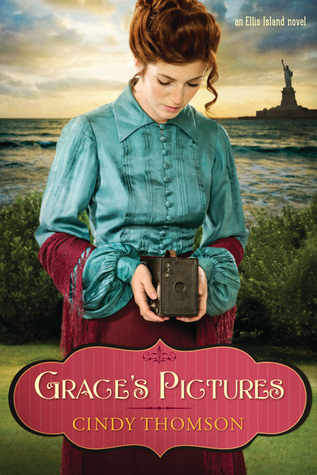
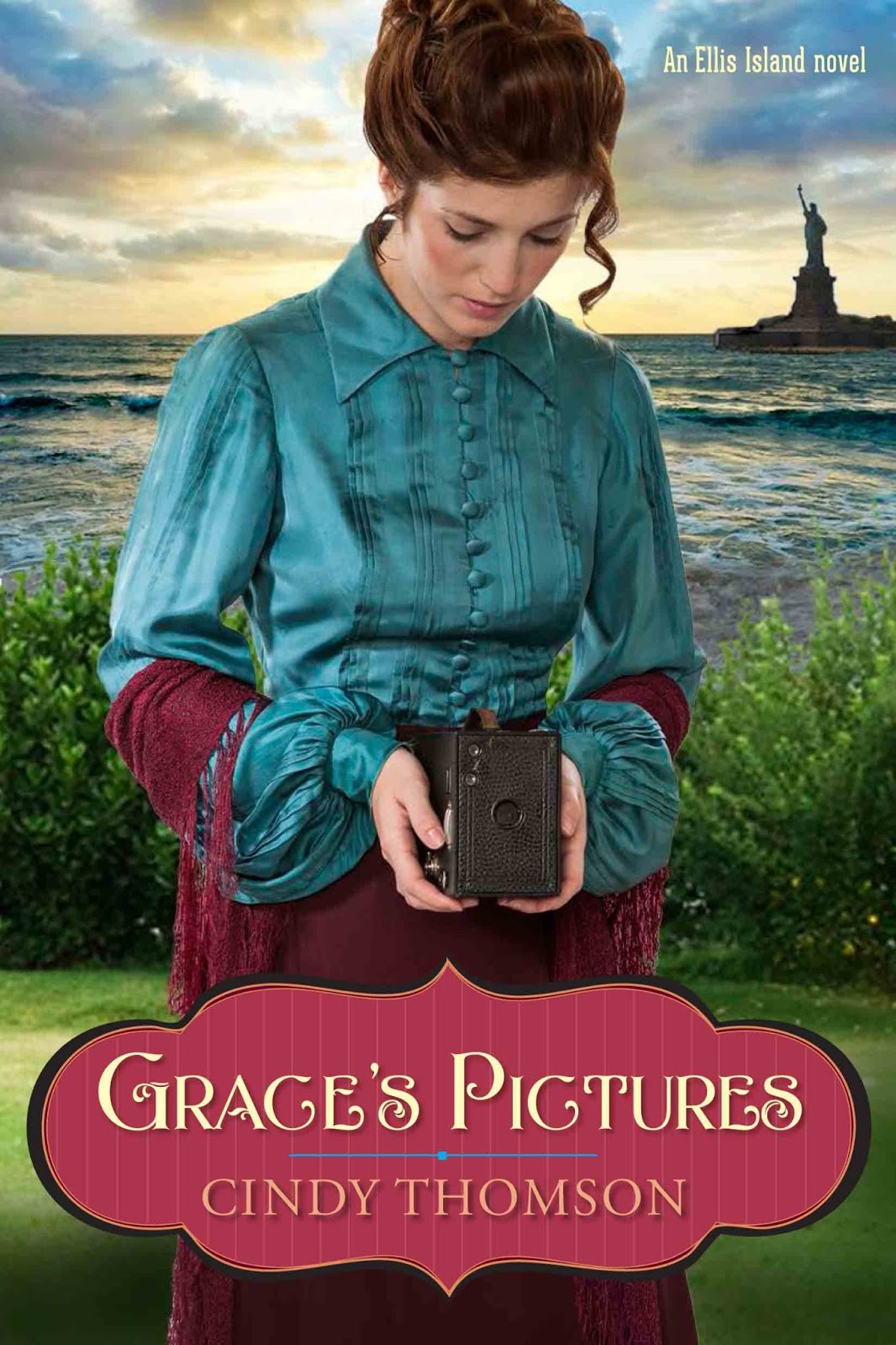
Grace McCaffery hopes that the bustling streets of New York hold all the promise that the lush hills of Ireland did not. As her efforts to earn enough money to bring her mother to America fail, she wonders if her new Brownie camera could be the answer. But a casual stroll through a beautiful New York City park turns into a hostile run-in with local gangsters, who are convinced her camera holds the first and only photos of their elusive leader. A policeman with a personal commitment to help those less fortunate finds Grace attractive and longs to help her, but Grace believes such men cannot be trusted. Spread thin between her quest to rescue her mother, do well in a new nanny job, and avoid the gang intent on intimidating her, Grace must put her faith in unlikely sources to learn the true meaning of courage and forgiveness.

Friday, June 7, 2013

What's An Irish Biddy?

In Grace's Pictures Grace McCaffery goes to work as a domestic servant. A vast many young Irish immigrant women were employed in the households of middle class families, like the Parkers in my story.

This was the era of the Industrial Revolution, and it came to housewives as well. Once a family could afford to hire a servant, they did so because although technology was advancing at a fast pace at the turn of the twentieth century, household chores were still difficult and time consuming. And the woman of this era sought to spend her time at more edifying endeavors such as gardening, working for social reform, and of course, the suffrage movement. (You see Grace on the cover with her Brownie camera and you might be tempted to think she had a lot of leisure time on her hands, but if you read the story you'll see that her leisure time was scarce and precious.)

Grace's mistress was not a pleasant lady. She referred to Grace as her "Irish Biddy." It was a bit of a derogatory term aimed at Irish immigrant women who commonly had the name Brigid or Bridget or Biddy for short. St. Brigid is one of the Irish patron saints, so like the name Patrick for boys, it was widely used.

When I was researching Grace's role as a domestic servant, I found a fascinating book called The Irish Bridget, Irish Immigrant Women in Domestic Service in America, 1840-1930 by Margaret Lynch-Brennan. The author uses the cases of real women and sometimes even their own words to describe what their lives were like.

What did an Irish Bridget do? She was cook, maid, waitress, child nurse, and laundress (according to the book.) Not always did they do all those things, but often that was the case.

A description of the typical girl who became an Irish Biddy is given in the book.

"For the most part, they were quite young girls...the median age of emigrant Irish females was about twenty-one. These girls were generally unmarried Roman Catholics who hailed from rural Ireland, and as the nineteenth century progressed into the twentieth, increasingly they came from the rural west of Ireland, where traditional Gaelic Irish culture persisted longer than it did elsewhere in Ireland. They were the daughters of people of limited means, rather than the children of either wealthy or extremely poor parents." 

In other words, they were poor and had little other choice for a future than to come to America. They had to learn their chores, however, as much of the housework done in North America was not typical in Ireland. They were hard working and determined women, however, and earned their place in the American economy.

I have great respect for them, and for Grace's character who is my representation of these women. I have found some young Irish servants in the census when researching my husband's family. Not mine, though. My ancestors were a little less than middle class. What about yours? Any Irish Biddys in your family? I'd love to hear stories!

Monday, June 3, 2013

Friday, May 31, 2013

Not Her Grandmother's Camera

In Grace's Pictures, Grace McCaffery longs to capture an image so that she can study it more closely. What better way to do that than with Kodak?

She tries sketching, but she's not very good at it. She visits a photographer and wants to learn about picture-taking, but he does not want her to get too close to his expensive equipment. Besides, he confuses her with all the technical terms, and she realizes the process would require time and study and she doesn't have much time. Besides being a means to freeze a moment in time, she believes photography could become a side business for her. She needs money in a hurry to bring her mother over from Ireland and save her from her peeler (policeman) husband.

The Advent of the Brownie

And then she discovers the Brownie camera. First introduced in 1900, this Kodak box camera was unique in a couple of ways. It was small and very portable. The user did not have to worry about the process of developing film. He or she just mailed the filled roll of film back to Kodak and soon the postman delivered your snapshots. (The snapshot was a new concept as well.) But perhaps the most appealing thing about the Brownie was that it cost only one dollar. To purchase a traditional camera outfit from Sears & Roebuck cost thirty times more! It was not as simple to use either. (Brownies were: crank the film, aim, shoot, and crank again.) Not to mention the fact that you had to develop your own film. What a mess!

An Invasion of Privacy

The introduction of the Brownie camera meant that the average person on the street could own one and carry it around. And, as someone commented in a contemporary newspaper, people could be taking photographs of folks who did not wish to be photographed. It was an invasion of privacy!

In Grace's Pictures, she commits this invasion of someone's privacy quite by accident. And in turn of the 20th century Manhattan, there were hordes of criminals about. And a corrupt police department. A naïve young immigrant girl could easily find trouble without looking.

The Brownie's Legacy

Brownie Hawkeye Flash 1960
Photo by Voxphoto
My family had a Brownie camera in the '60s and it operated pretty much the same way. The Brownie was an ingenious invention that did change society. I wonder what those folks would have thought about our smart phones today. We can take moving pictures of strangers now and instantly post them for the world to see.

Do you have any Brownie camera memories? I would love to hear them!

Tuesday, May 21, 2013

The Faces of Your Ancestors...

...could be here.

Many of these photographs used in this video were taken by Augustus Sherman. He appears in my novel, Grace's Pictures, and takes Grace McCaffery's photograph as she prepares to leave Ellis Island. These faces hold so many stories--the reason I wrote this book.


Tuesday, April 30, 2013

Grace Is On Her Way!

My author copies arrived today, which means it won't be long until release day!

So pretty. And they smell good too!


Friday, January 11, 2013

Look!!

These are ARCs (Advanced Reader Copies) for media outlets. Excited to hold an actual book, words from my imagination. And blessed to have Tyndale publish it.

Know of any local media (in Ohio?) Let me know.